
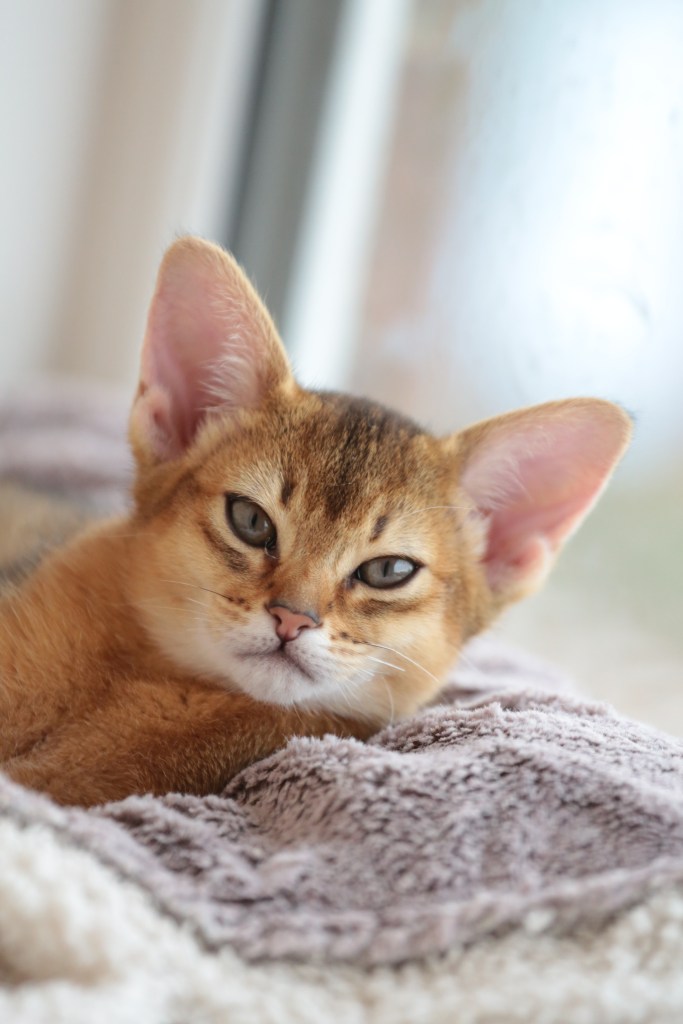
The Abyssinian with its little “Wild Cat” looks is widely considered one of the oldest cat breeds. The first mention of the breed is when an “Abyssinian” cat took a prize at the Crystal Palace show in 1871.
The original cats were reported to have been imported from Ethiopia (formerly Abyssinia) around 1868 possibly by Capt. and Mrs. Barrett Lennard whose male Zula is often assumed to be the first Abyssinian and as such father of all modern Abyssinians. However, there is no hard evidence to support this. It is equally possible that several similar cats were brought to the UK due to the British troops returning from the war in Abyssinia that year.
The Abyssinian has often been considered the sort of cats worshipped by Ancient Egyptians, with their regal posture and statuesque qualities. Although the exact origins of the Abyssinian are not known it is undisputed that the
Egyptians both worshipped and venerated the cat. It was not until the Roman conquest of Egypt that cats could be exported from Egypt. It is thought that having seen how these cats kept the vermin down in the grain stores of
Egypt, the Roman army aided in their introduction to much of Europe, including Britain where they most likely outstayed the Roman exodus and interbreed with the native feline population Filis Silvestris – the European Wild Cat, which is genetically compatible.
Unfortunately, due to a lack of written records being kept by early breeders and the fact that there was no formal registration system, it is impossible to trace the true ancestry of these original cats. Although other possible origins
have been suggested, such as the coast of the Indian Ocean or the South East of Asia. Even though the origins are difficult to trace, the Abyssinian breed was developed and refined in England and while it will appear in the Foreign
section at cat shows it is recorded as an English breed.
Breeders of these early Abyssinian Cats had to wait until 1929 before it became recognized by the GCCF (Governing Council of the Cat Fancy). Since then the breed has become increasingly sought after and has been exported around the world. This popularity is due in large part to the nature and intelligence of the cats as well as their striking physical appearance. The “Aby look”, wild but not savage, centres around the cat’s large and expressive eyes, that reflect beautifully the intelligent, mischievous, demanding, affectionate and sensitive inner cat. The characteristic markings above the inner edge of the eye and from the outer edge of the eye towards the ears. The glorious and distinct ticked coat (or agouti) with its characteristic three to four bands of colour tipped in the ticking colour.
The lithe and muscular body of medium size and the delicately shaped legs and paws. Although the body shape and texture of the coat have varied widely, due in great part to the need to import new bloodstock into Britain as a result of the breed nearly being wiped out by the two World Wars and again in slightly more recent years as a result of widespread feline leukaemia (FeLV), before testing and immunization being available. As such the native gene pool was too small to sustain itself and produce genetically sound offspring, so several pioneering Abyssinian breeders imported cats from Holland and America that descended from British stock exported a few generations before. There were also several Australian, New Zealand and Scandinavian cats imported to further diversify the gene pool.
Abyssinian cats are loyal, intelligent, independent and love to head-butt their owners. They are quite talkative cats, though they have a sweet chirruping, trilling voice which is quite endearing, unlike the yowl of a Siamese! Many are fascinated with water and love to play with it and even in it. Also, they love to play with toys, other cats and people, Abys are quite capable of learning to play games like fetch, especially if rewards are offered. Most of all they are very loving cats, yet not of the usual lap cat verity, but they certainly make it extremely clear that they love you and value your company!
The breed is recognized in seven classes at full championship status in the UK, these are Usual (Ruddy), Chocolate, Sorrel, Blue, Lilac and Fawn, the fifth class being the same four colours but with a Silver base. Other new colours are being introduced such as Tortie, including sex-linked Red and Cream, plus combinations of these and the existing colours, however, these are still comparatively rare. So all in all Abyssinians come in 28 different recognized colours, but at the heart of it, they are all the same, loving, loyal, intelligent, inquisitive and playful cats.
The number of kittens in an Abyssinian litter varies from cat to cat but averages around three or four. Most breeders will allow a cat to have three litters in about two years, but this depends entirely on the health of the mother.
It is important that they have a chance to rest fully between litters or you risk both the health of the mother cat and that of the kittens too. Abyssinians are happiest as a pair but will relate readily to being a single cat provided there is
enough stimulation and company for them. In a multi-cat breed household, you will often find the Abyssinians herding together much of the time. They are usually best kept as indoor cats as they rarely have any road sense! An average Abyssinian will live to fourteen or fifteen years old, but many out there go on into their twenties.
Courtesy of Jacquie Barnes-Hookey 2015
 ABYSSINIAN CAT ASSOCIATION